


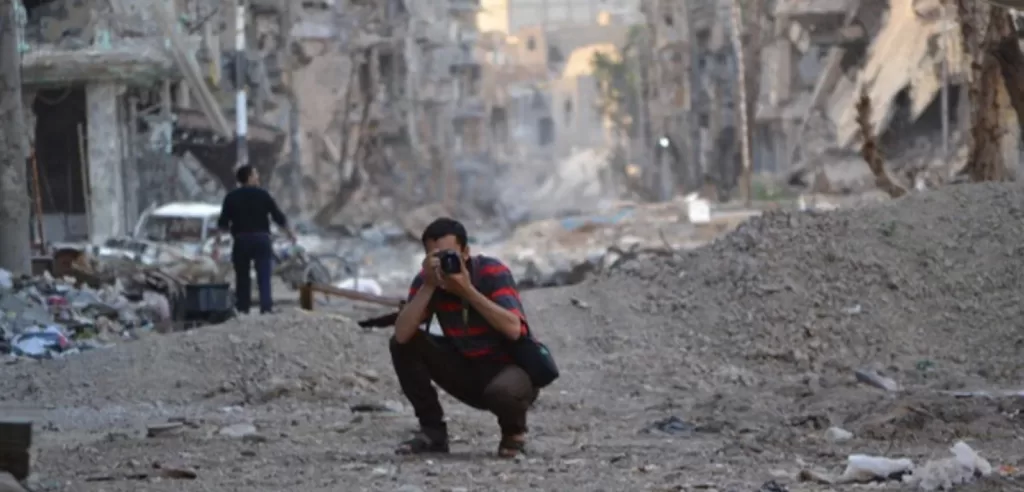
Leur vocation journalistique s'est forgée pendant le conflit en Syrie avant d'émigrer à Madrid, où ils ont lancé le premier média géré par des réfugiés en Espagne: Baynana, un journal en ligne en arabe et en espagnol.
Aged between 22 and 39, Mohammed, Ayham, Moussa and Okba all come from the Syrian city of Daraa, in the south, where the revolt against Bashar al-Assad’s regime began in March 2011.
Leur exil les a emmenés en Turquie début 2019, avant de s'envoler pour Madrid en mai de la même année grâce au Comité pour la protection des journalistes (CPJ), une ONG basée à New York.
“When the war started, I was 12 years old, but I knew very well what was going on, because a lot of people were coming out to demonstrate near my home, at the mosque,” Okba Mohammed told AFP. youngest member of the group, which got tough from 2015 in local media where, he said, he was filming “demonstrations” and “bombs”.
For his part, Mohammed Subat explains that Spain was his “favorite country, because I was very interested in football”.
“I never imagined coming here as a refugee or a migrant, I imagined coming as a tourist or a student, but this is how life is”, adds this 31-year-old man, who says he collaborated – first in Syria, then in Turkey – with Syria TV, an opposition channel based in Istanbul.
- “The good face of migrants” –
The aim of this brand new digital magazine launched on April 7, whose name in Arabic means “Between us”, is to show “the good face of migrants here in Spain”, explains Ayham al Ghareeb, 32, who came in Madrid with his wife and two little daughters.
This is why the four reporters chose from the start to tell “success stories”, like that of Ashraf Kachach, a “youtuber” of Moroccan origin who fights against Islamophobia, or that of Malak Zungi, a Lebanese woman who helps refugees to train as chefs in Spain.
Sans oublier le footballeur marocain Youssef En-Nesyri, attaquant du Sevilla FC, l'une des meilleures équipes de football du pays, qui incarne le succès au championnat espagnol dont tant de jeunes du Moyen-Orient et d'Afrique du Nord rêvent.
Another reason for Baynana’s existence: to provide “useful information” to the Arabic-speaking community because in Spain, “there is not a lot of information in Arabic to carry out formalities” such as obtaining a residence permit, explains Ayham al Ghareeb.
Un problème auquel ces journalistes sont eux-mêmes directement confrontés en tant que demandeurs d'asile. Au total, plus de 20 000 Syriens ont demandé l'asile en Espagne depuis 2011, selon la Commission espagnole d'assistance aux réfugiés (CEAR).
“I have been in Spain for two years and I still cannot travel or see my family,” laments Okba Mohammed, who has not seen his relatives, refugees in Jordan, since 2014.
“Life in Spain is very safe”, but “there is also racism against migrants and refugees”, for example when looking for an apartment, adds Ayham al Ghareeb.
- Large potential audience –
Baynana bills itself as the first refugee-led media outlet in Spain, a similar initiative having taken place in Germany with the digital magazine Amal Berlin (“Hope Berlin” in Arabic).
In a country of around one million Arabic speakers, its potential audience is “very large”, explains Spanish journalist Andrea Olea, coordinator of the project and responsible for translating and adapting articles by her four Syrian colleagues into Spanish.
It goes “from Moroccans who come to work in the fields to refugees who may have a higher socio-cultural level” because they have a university education, she continues.
La rédaction de baynana.es/es est une salle modeste du siège de la fondation espagnole Por Causa, qui veut promouvoir le journalisme d'investigation et le travail sur la migration et qui a apporté un soutien logistique à la revue, dont les moyens sont modestes.